📥 Upload/Delete/View validator keys
Deposit queue
We encourage operators to see the queue before submitting new keys, as they may have to wait some time to get deposits, and there's a key removal charge for removing keys while in the queue.
Stake is allocated to uploaded keys through a queue. You can see a visual representation of it under the deposit widget, or at the top of the View Keys tab.
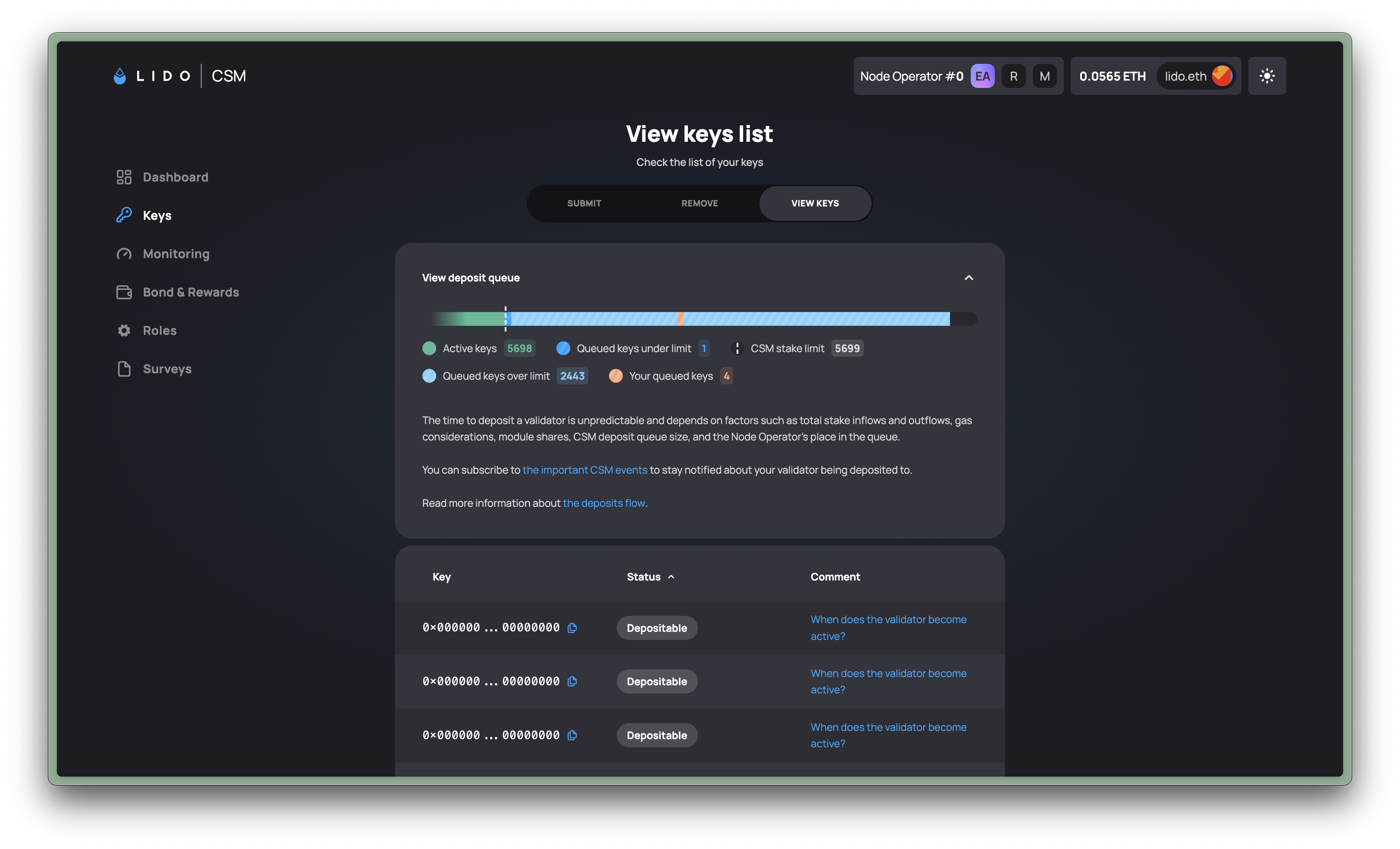
The default queue is FIFO (first in, first out), so keys are served in the order they were submitted. Some operator types are also eligible to have a limited number of keys deposited through a higher-priority queue, which is processed before the default one. See Stake allocation queue for the full mechanics.
In 0x01 CSM, each key receives a single 32 ETH deposit once the queue reaches it.
In 0x02 CSM, keys are funded in two phases. The queue above allocates the initial 32 ETH deposit that activates each validator, and a separate top-up queue then adds stake up to a target slightly below the 2,048 ETH maximum to avoid overfilling. Top-ups depend on the module's stake share limit and overall deposit demand, so a validator may never reach that target, and both phases can take longer than a standard 32 ETH deposit.
Upload keys
Your deposit data must use the withdrawal credential type of the module you are joining, 0x01 for 0x01 CSM or 0x02 for 0x02 CSM. See Generating Validator Keys before you upload.
- Go to the Lido CSM Widget and connect your wallet. MAKE SURE THAT YOU ARE ON THE CORRECT NETWORK (i.e., Mainnet or Hoodi).
- Mainnet: https://csm.lido.fi/
- Hoodi: https://csm.testnet.fi/
- Select
Become a Node Operatorand thenCreate a Node Operator. If you don't have an operator yet, you first choose your operator type, which determines the module you join and the bond you post. - On the Lido CSM Widget, upload your
deposit data fileand select the corresponding bond type (ETH, stETH, or wstETH), and provide the desired bond amount. Learn more about bond requirements.
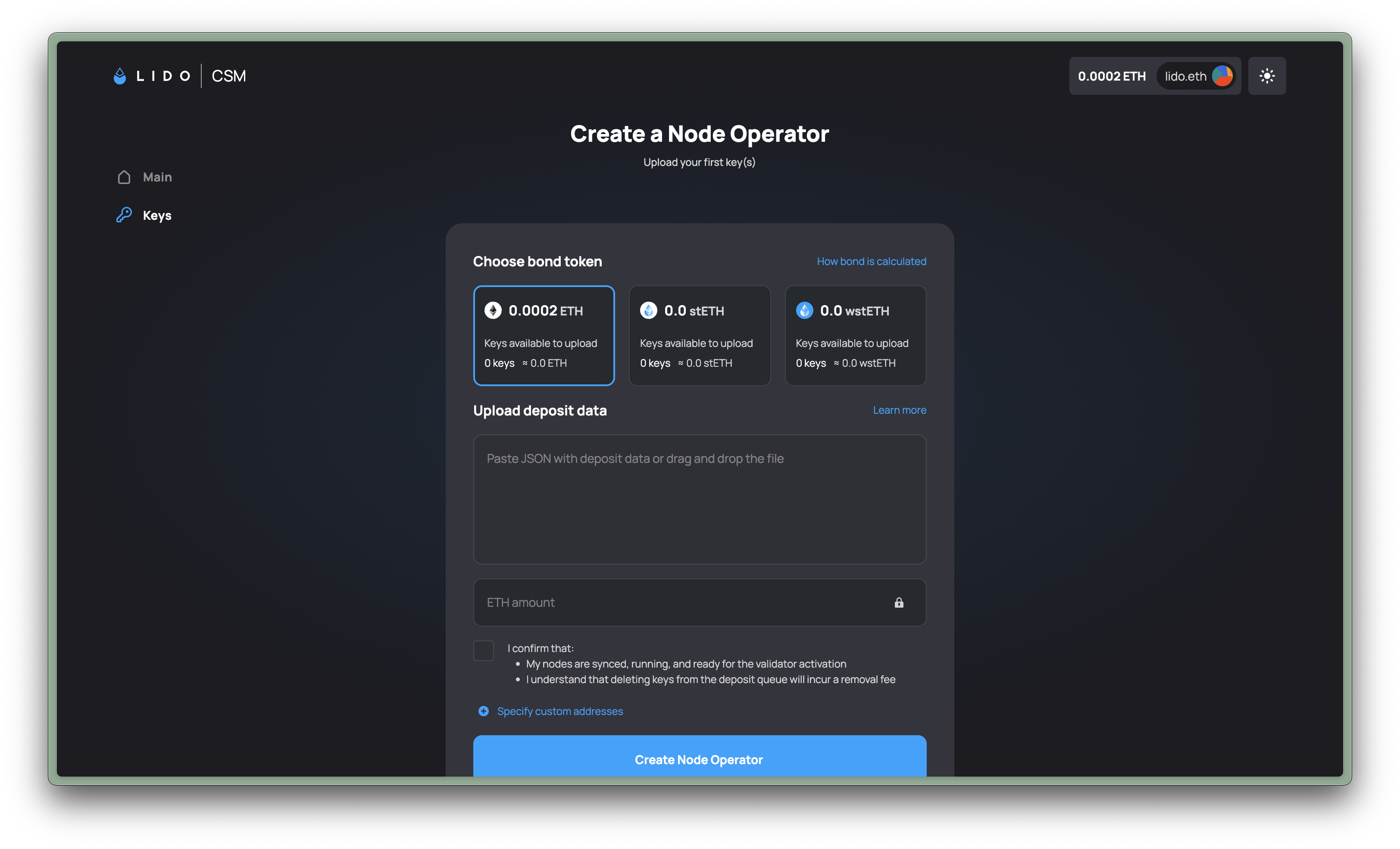
- Copy & Paste
- Upload File
Print the contents of the deposit_data.json file on your node machine, then copy & paste the contents into the CSM Widget directly.
- Identify the actual file name of your
deposit_data.jsonfile on your node:
find ~ -name "*deposit_data*" 2>/dev/null
The output will be a file path to your deposit data.
- Print the contents:
cat <FILEPATH_TO_DEPOSIT_DATA>
# replace with the actual file path
Transfer the deposit_data-<timestamp>.json file from the USB used in the validator key generation step onto your working device (e.g., laptop with MetaMask), then upload the file.
- Finally, select
Submit, sign the transaction with your connected wallet, and you are all set. - Now you just need to wait for the Lido CSM to deposit your validator keys (using your
deposit data file). This is a first-in, first-out process so expect a queue when demand is high. More details on this process here.
DO NOT DEPOSIT 32 ETH using the deposit data file generated this way, as the Lido CSM will make a deposit for you.
Doing so will result in a loss of funds.
Remove keys
The Node Operator can delete uploaded keys voluntarily (e.g., duplicate keys) if it has not been deposited yet.
A fee is confiscated from the Node Operator's bond on each deleted key to cover maximal possible operational costs associated with the queue processing. Keys (via the deposit data file) can be deleted in continuous batches (e.g., from index 5 to 10).
More details here.
- Go to the Lido CSM Widget, under the KEYS header
- Select the DELETE tab on the widget
- Press the Remove button
- Select the keys you want to remove
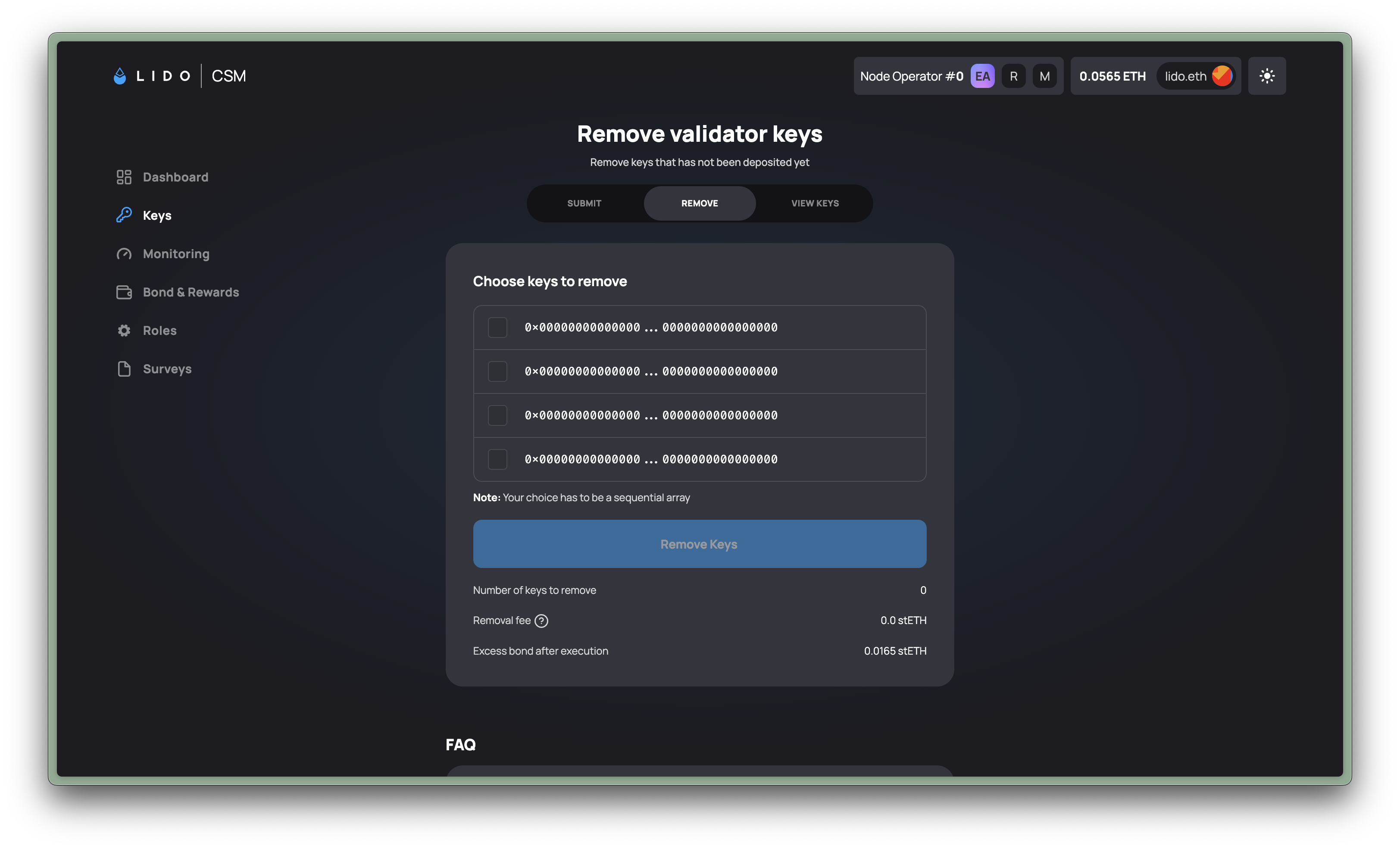
Once your keys have been removed, the associated bond amounts that you deposited earlier will be available for claiming under the Bond & Rewards tab. You can learn more at the Rewards & Bonds page of this guide.
Keys that have been deposited cannot be removed and can only be manually exited from the Consensus Layer or ejected via triggerable withdrawal requests to the protocol.
Eject keys
CSM now supports ejecting validators via Execution Layer Triggerable Withdrawals (which requires an ejection fee).
However, this is not the standard exit flow. This method should be used only as a last resort, such as when you have lost access to your validator keys.
- Go to the Lido CSM Widget, under the KEYS header
- Select the DELETE tab on the widget
- Press the Eject button
- Select the keys you want to eject
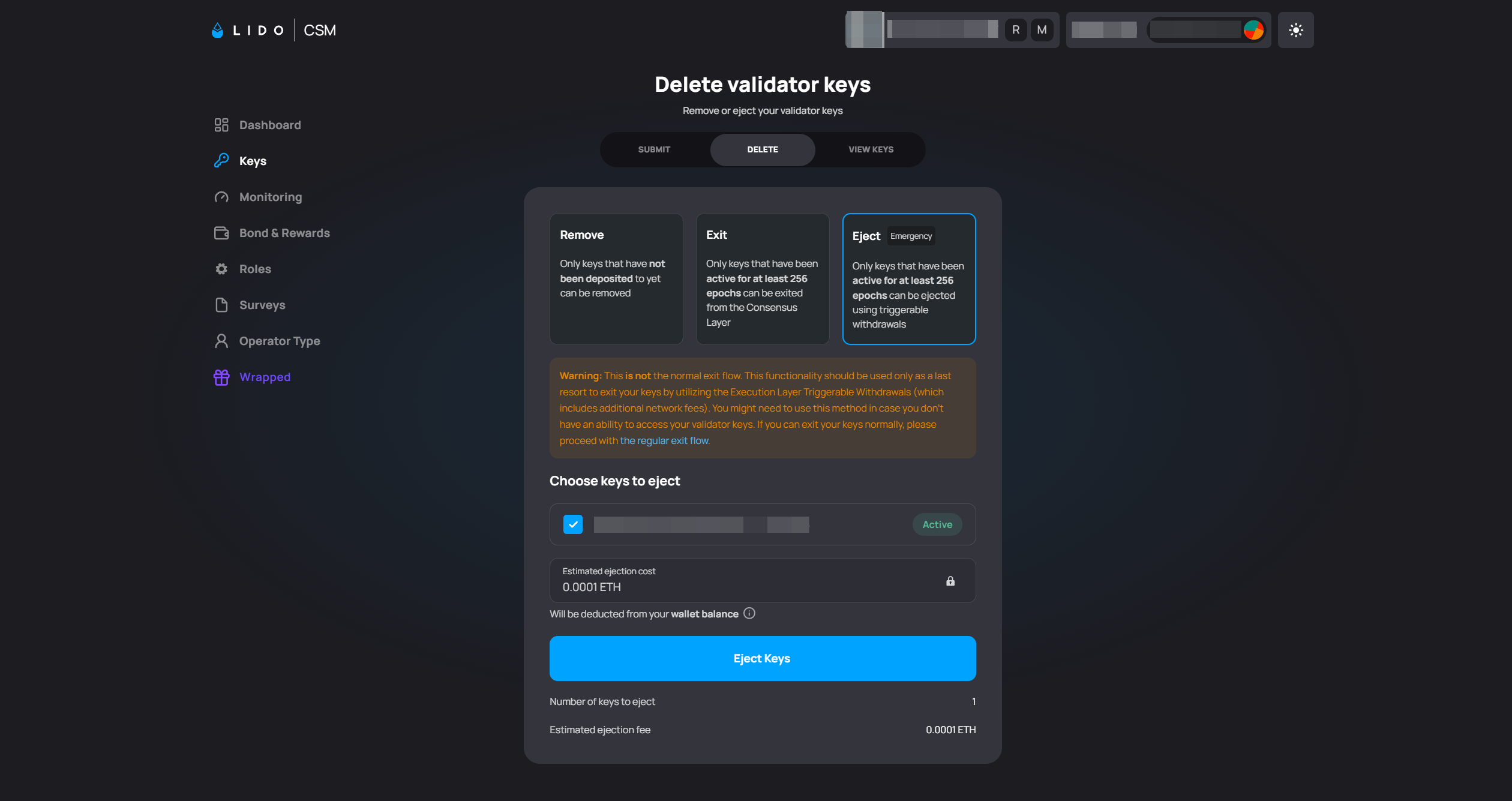
Once the validators are fully exited, you can claim your locked bond.
View keys
You can also view the status of the keys pertaining to your uploaded deposit data file and take the necessary actions.
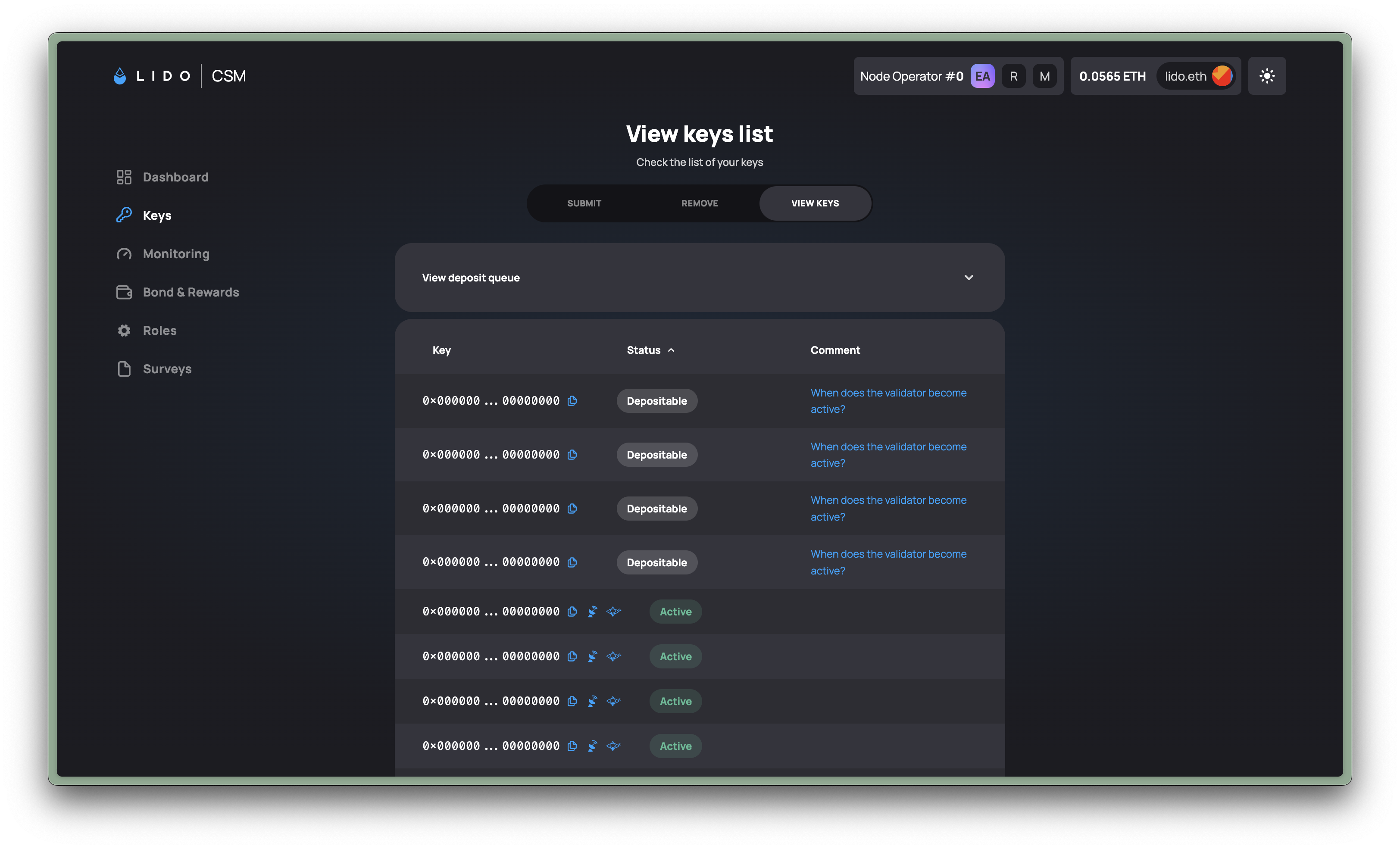
In 0x02 CSM, a key shown as Active may still be receiving top-ups toward its 2,048 ETH maximum.
Key lifecycle
| Status | Meaning | Action |
|---|---|---|
| Unchecked | Uploaded; awaiting validation | Wait. Remove earlier Invalid or Duplicated keys |
| Depositable | Valid and sufficiently bonded; awaiting deposit | Maintain sufficient bond |
| Non queued | Depositable, but not currently in the queue | Resolve any Unbonded keys. If still Non queued, use Normalize queue in the widget to add them to the deposit queue. |
| Activation pending | Deposited; awaiting activation on the beacon chain | Keep your validator online and ready |
| Active | Active on the beacon chain | Keep validating |
| Exit requested | The protocol has requested an exit | Exit the validator within the allowed time |
| Exit initiated | An ejection request has been submitted | Monitor progress; keep validating until exit |
| Exiting | Exit is scheduled on the beacon chain | Keep validating until exit |
| Exited (withdrawal pending) | Exited; ETH withdrawal is pending | Wait for withdrawal |
| Withdrawn | ETH has been returned to the protocol | Claim available bond and rewards under Bond & Rewards |
Warnings and errors
| Status | Meaning | Action |
|---|---|---|
| Unbonded | Insufficient bond for this key | Active: top up bond or exit. Not active: top up bond or leave pending |
| Strikes | Performance strikes may lead to ejection and a penalty | Improve performance |
| Slashed | Slashed on the beacon chain | Review your setup; see Slashing Prevention |
| Duplicated | Key uploaded more than once | Remove duplicate key |
| Invalid | Invalid deposit signature | Remove key |