🔄 Consolidations & Migration
CMv2 runs only 0x02 validators with balances up to 2,048 ETH. If you are migrating from CMv1, your existing 32 ETH (0x01) validators should be consolidated into new 0x02 validators.
This is a one-way process from CMv1 source validators to CMv2 target validators. CMv1 validators are not exited and redeposited; they are consolidated at the Ethereum protocol level. Operators that do not complete the CMv2 migration requirements, such as providing bond and keys, will have their CMv1 validators exited eventually.
What consolidation means
Consolidation is an Ethereum-native mechanism that moves stake from a source validator into a 0x02 target validator. The source validator exits and its balance merges into the target. The process is handled at the Ethereum protocol level and cannot be reversed.
Each consolidation request enters a consolidation-exclusive queue on the consensus layer. Please note that while queued, both source and target validators must remain active and healthy.
Total time from submission to completion depends on queue depth at the time of submission and cannot be predicted in advance. A 256 epoch (~27 hour) withdrawable period exists between the exit of the validator and the consolidation of its value into the target, and rewards do not accumulate during that period.
During periods of high migration activity across the network, waits may extend to several days or weeks.
You can monitor the consolidation queue using external services such as Validator Queue, Pectrified, or Miga Labs.
Migration process
For the current migration periods, readiness requirements, and coordination instructions, see the CMv2 Migration — Node Operator Overview. NOM coordinates timing directly with each organization.
Migrating from CMv1 to CMv2 is a two-step process. First set up your CMv2 footprint, then consolidate validators into it.
Onboard and prepare your CMv2 validators as early as requested, but only begin consolidation according to the migration period and instructions shared by NOM.
Preparation
Before starting, ensure the following:
- Confirm you can post the required bond for your intended CMv2 footprint.
- Validator clients, signers, and monitoring support
0x02validators and consolidation events. - Current CMv1 validators are mapped to infrastructure, so you know which clusters to retire first.
- Keep the requested number of CMv1 validators and depositable keys available until NOM confirms they are no longer needed.
- Maintain a buffer of additional depositable keys across your CMv2 Operator Group so incoming stake can still be allocated.
- Be prepared to process voluntary exits if NOM determines they are needed to fund the initial 32 ETH deposits for CMv2 validators.
Step 1: CMv2 setup and initial seeding
- Create CMv2 Node Operators in the CMv2 widget (see Creating & Managing Node Operators), set a manager address, rewards address, and confirm operator type. This is an administrative step and does not touch validator infrastructure yet.
- Generate
0x02validator keys using your standard key management tooling. - Upload keys and post bond. Post bond either before or during key upload so validators can receive initial deposits.
- Bring CMv2 validators live. Configure validator clients, fee recipient (Lido EL Rewards Vault), MEV-boost, ejector settings, and monitoring.
- Wait for your new validators to be deposited (32 ETH) and become active. Validators must pass through Ethereum's entry queue, so delays in uploading keys will also delay the start of consolidation.
Step 2: Consolidation
-
Initiate via EasyTrack. Submit a motion specifying the source CMv1 operator, the target CMv2 sub-Node Operator(s), and a consolidation manager address. Once enacted, stake transfers from the CMv1 entity to its corresponding CMv2 entity are permitted.
-
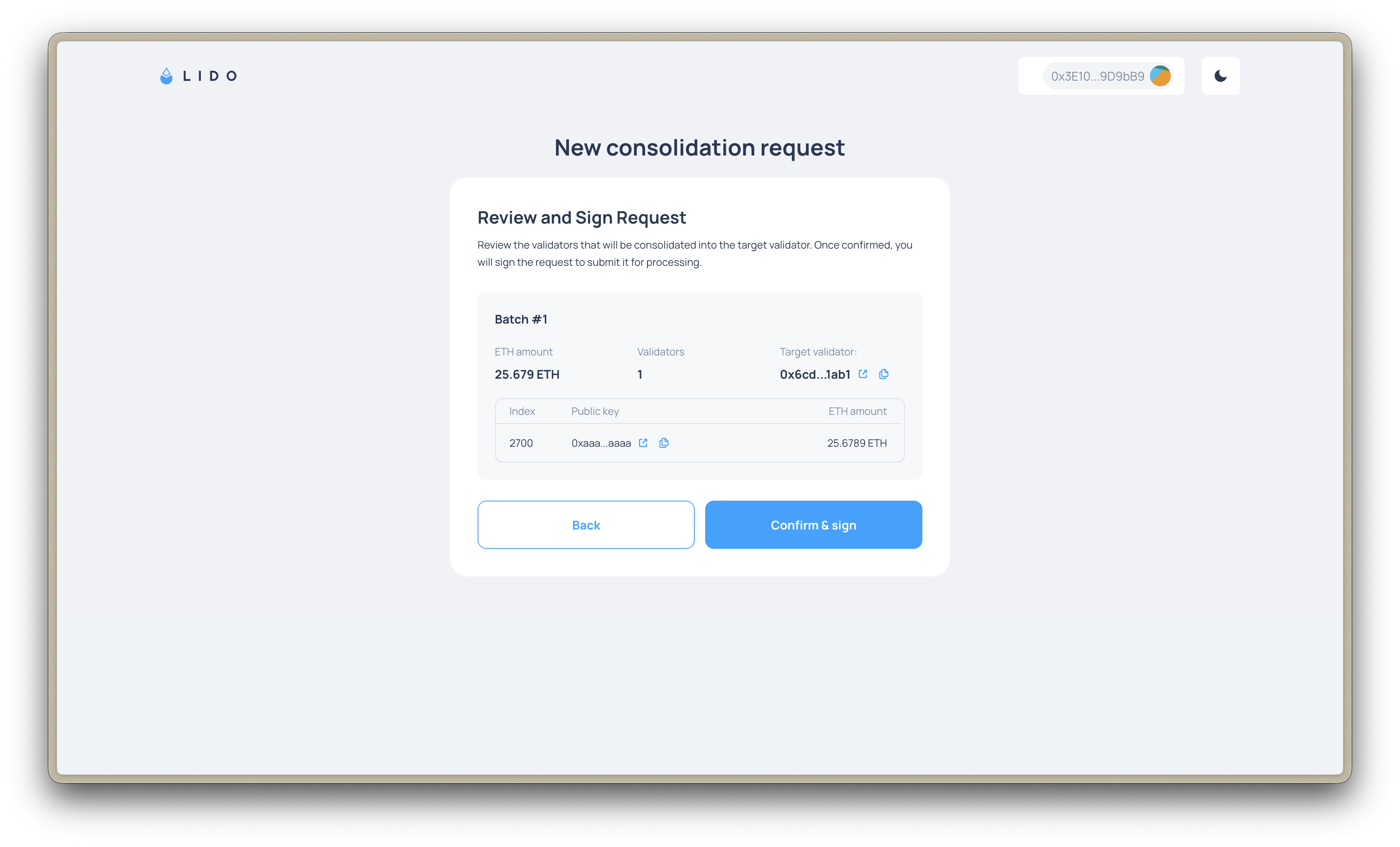
Submit consolidation batches using the Mainnet Consolidations interface, specifying which CMv1 source validators consolidate into which CMv2 target validators. For testnet operations, use the Hoodi Consolidations interface.
-
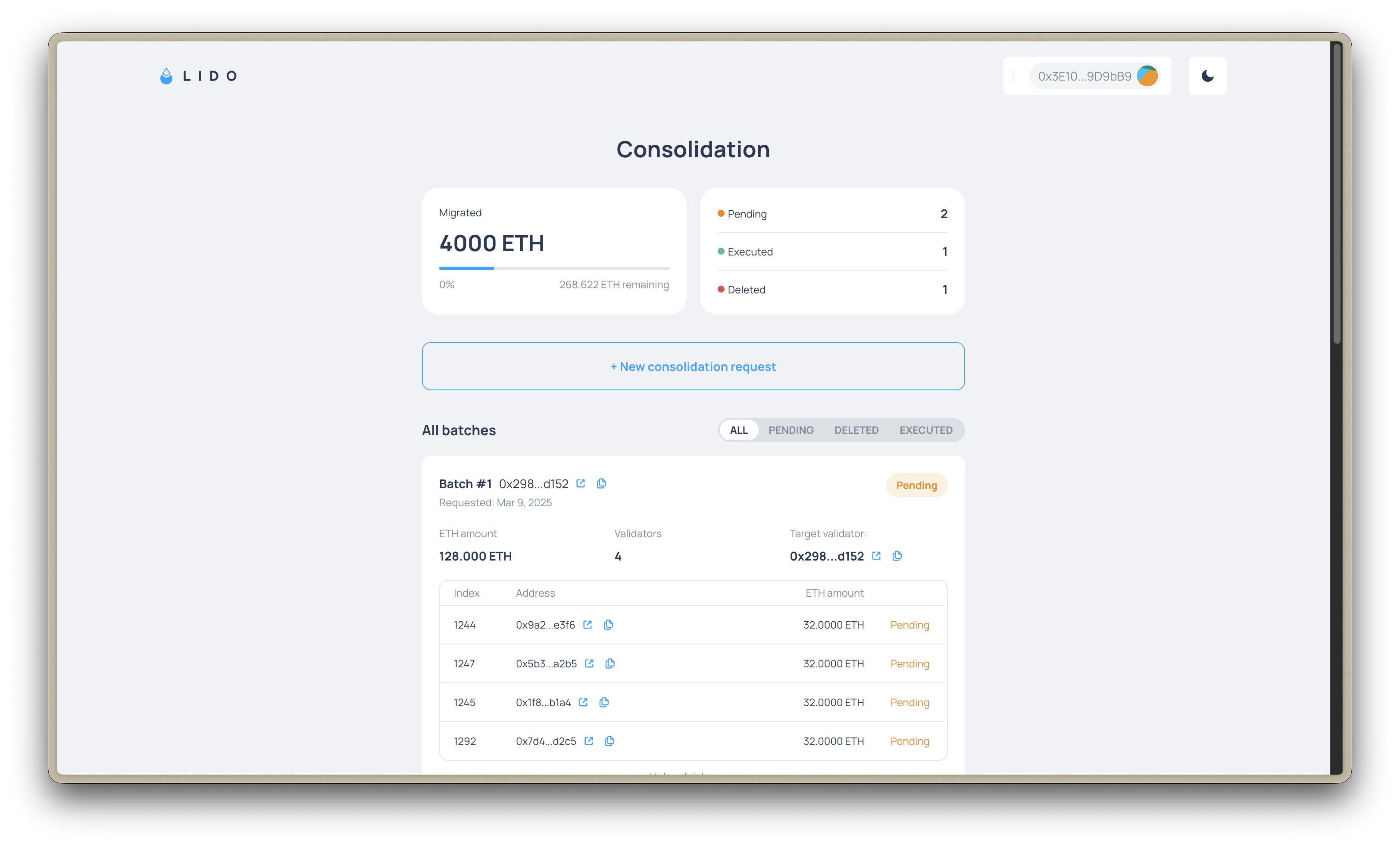
Monitor progress. Track queued, in-progress, and completed consolidations in the same interface.
Mainnet addresses for the Consolidation Migrator, Consolidation Bus, and Consolidation Gateway are listed under the Consolidation Stack.
Wind-down
Once all consolidations for a given operator are complete:
- Confirm that the source CMv1 validators have no remaining duties. Their stake is now fully represented in CMv2.
- Decommission CMv1 infrastructure cluster by cluster once no active keys remain. Do not decommission early. Premature shutdown risks missed duties.
- Verify CMv2 validators reflect expected stake, bond is posted correctly, and all tooling is aligned.
Operators during migration
A single Node Operator can run multiple sub-Node Operators, each with its own type, bond, and configuration. This allows operators to segment their setup, for example, running standard infrastructure under one sub-Node Operator and DVT under another.
All bonding, fees, and parameter enforcement apply at the sub-Node Operator level.
Creating a new sub-Node Operator is permissioned and requires DAO approval via the CMC onboarding process.
Bond during migration
Bond must be posted at the sub-Node Operator level before validators can receive initial deposits. It can be posted ahead of time or during key upload.
Mainnet bond amounts depend on operator type, see Bond & Key Management for details.